
For the last 30 years, if you were flying to the Dominican Republic, you were likely heading East. Punta Cana has been the undisputed heavyweight champion of Caribbean tourism, transforming a coastline of coconut palms into a global powerhouse of 90+ resorts.
But the Dominican government, in partnership with six major international hotel conglomerates, is officially looking West.

In what is being called the most ambitious tourism project in the Caribbean’s history, the nation has broken ground on The Cabo Rojo Development Project in the province of Pedernales. This is not just a new cluster of hotels; it is a master-planned destination built from scratch on the remote southwestern coast, designed to offer a level of “Eco-Luxury” that Punta Cana cannot match.
The Master Plan: Cabo Rojo By The Numbers
To understand why this is different from just “another resort zone,” you have to look at the scale. The project is a public-private partnership (PPP) valued at over $2.2 billion USD.
Unlike the sprawling, sometimes chaotic growth of Bavaro, Cabo Rojo is being curated with military precision. The master plan covers 38 million square meters, but—crucially—has a strict low-density mandate.

While Punta Cana is famous for its mega-resorts stacked side-by-side, Cabo Rojo is capped at 12,000 rooms total, to be built over ten years. The focus here is not volume; it is value. The goal is to attract a higher-spending demographic looking for nature, silence, and exclusivity—travelers who might usually book trips to Tulum or Costa Rica rather than a traditional all-inclusive.
Who Is Building? (The Concrete Details)
We have moved past the “rumor” phase. Bulldozers are currently active, and the first wave of hospitality giants have signed definitive agreements.

Iberostar Group was the pioneer, launching construction on the first 580-suite property. But the biggest news for American travelers came from Hyatt’s Inclusive Collection. They have confirmed the development of two flagship properties:
- Secrets Cabo Rojo: An adults-only sanctuary focused on couples.
- Dreams Cabo Rojo: A high-end family concept.
These are not “future concepts.” The foundations are being poured, with opening dates targeted for mid-2026. Following them are confirmed projects from Hilton, Marriott, Sunwing, and Karisma, ensuring that loyalty program members from every major U.S. chain will have redemption options in this new frontier.
Infrastructure: The Airport and The Port
You cannot fill luxury hotels without a runway. The government has fast-tracked the construction of the Cabo Rojo International Airport (CRIA).

Located just 20 minutes from the hotel zone, the airport is being built by Spanish infrastructure giant Acciona. Phase one includes a 3,100-meter runway capable of handling wide-body jets from Europe and the United States. Until this facility opens in 2026, the region remains difficult to access (a 5-hour drive from Santo Domingo), keeping it exclusive for now.
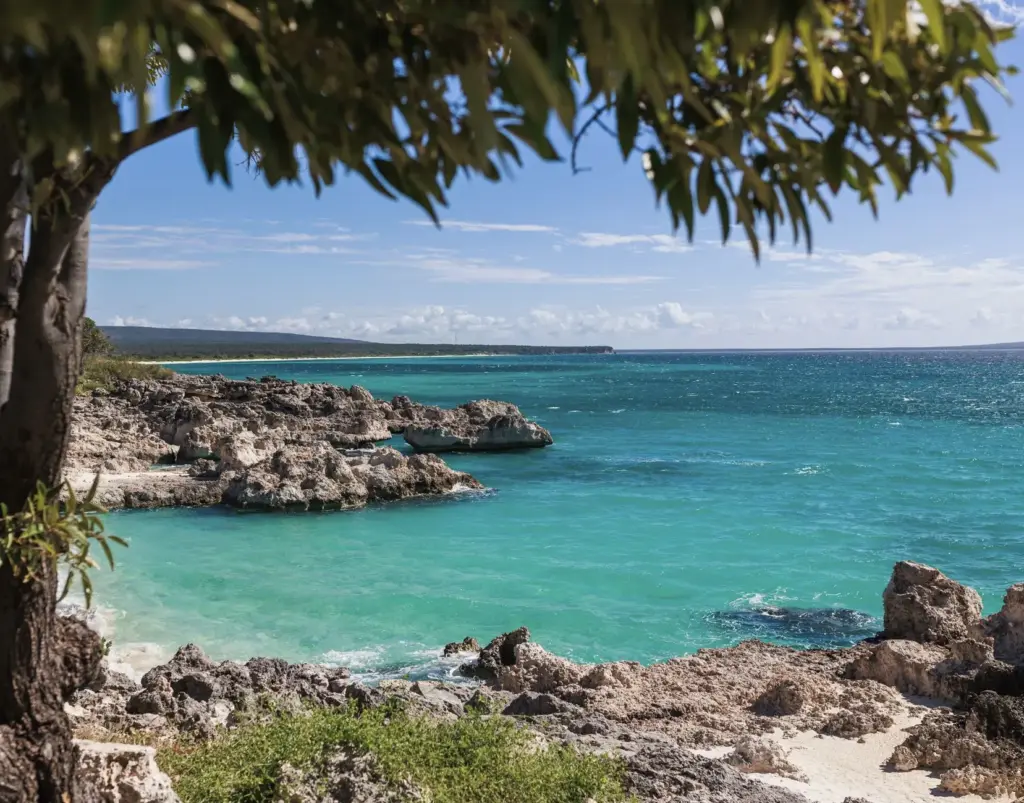
However, tourists are already arriving by sea. Port Cabo Rojo is fully operational. In 2025, it began welcoming major cruise lines, including Royal Caribbean and Norwegian, giving thousands of day-trippers the first glimpse of the famous Bahía de las Águilas—a 5-mile stretch of beach often cited as the clearest water in the world.
Showdown: Old vs. New
Is Cabo Rojo worth the wait?
Cabo Rojo (Pedernales): Rugged, eco-focused luxury. Think “Tulum before it got crowded.” It is for nature lovers who want silence and untouched sand.
Cabo Rojo (Pedernales): Currently requires a long drive (5 hours from Santo Domingo) or a domestic hopper flight. The new international airport opens in 2026.
Ready to book? Find the best time to fly here.
The “Wild West” Factor vs. Safety
Pedernales is technically a border province, sitting next to Haiti. For many travelers researching resort safety, this geography raises red flags.
However, the geography acts as a natural fortress. The Cabo Rojo development is isolated from the border by miles of protected national parkland (Jaragua National Park). Furthermore, the Dominican government has deployed a specialized POLITUR (Tourist Police) task force to the region, creating a “secure corridor” similar to the one that has successfully protected Punta Cana for decades.
The Verdict
This is not just “Punta Cana 2.0.” It is an evolution. By limiting density, banning high-rises, and focusing on the stunning natural landscape of the Southwest, the Dominican Republic isn’t just trying to compete with Mexico—it’s trying to steal the crown from luxury destinations.
Subscribe to our Latest Posts
Enter your email address to subscribe to Dominican Republic Sun’s latest breaking news affecting travelers, straight to your inbox.